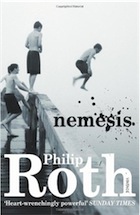
Roth is known for writing magically precise books. Prose that is as polished as the brass railings on an old style fire truck. Nemesis is a gem.
Short, about 230 pages, you'll breeze through this in a couple of sittings. Not just because of the word length but because the narrative is so seamless.
This is one of the most assured storytellers writing today. Roth begins with a factual account of how the Polio epidemic first hit the Newark area in the summer of 1944, before zooming in on the main subject of his novel, Bucky Cantor. Athletic, pure of heart, hard working. Cantor is a physical education teacher and a playground instructor. He loves teaching sports to young boys, seeing them evolve into men. An accomplished diver with a powerful physique, Bucky is however devastated when his poor eyesight prevents him from joining the Marines to serve in WW2. His two best friends head to Europe for the D Day landings. Bucky teaches baseball. Then the illness takes grip.
Roth is writing about his childhood here, about an epidemic many will have forgotten. Polio was defeated in the 1950s, but too late for the thousands who succumbed to it in the early part of the 20th century. It spreads around Newark like a plague. People are in a panic.
Bucky stands tall. He lends support. He encourages the kids to keep playing. Not to worry. But his girlfriend is desperately afraid for him and engineers a job offer -- a chance to get out of Newark, and away from the plague. He is determined to turn it down, but his desire to see her, to have a happy life, takes over. He takes the job. He heads to the mountains.
We discussed Nemesis in our book group and the section at the camp was the only one that drew any criticism. It seemed "too perfect". I can't really agree. This is a nostalgic passage. I sense that Roth is trying to capture something of his childhood here, and in doing so speaks volumes for America of the 1940s, for its ambitions. Its innocence. I found myself wishing I could spend my summers in camps like the one here, at Indian Hills. I'd love to swim in that lake too. I'd even eat the macaroni cheese.
Spoiler alert

What happens to Bucky is devastating but, as with all great stories that are well told, utterly inevitable. The polio follows Bucky to the camp and strikes his closest friend there. He becomes convinced he is the carrier -- and medical tests prove he has the virus. He falls ill just days later.
Roth wraps the story up cleverly. He projects forward twenty years. Bucky is now an older man and we learn that the narrator of the book is one of the kids from the playground, who caught polio himself, became crippled, but survived.
There is a stark contrast between them, however. The narrator has coped, built a life for himself, had children, a relationship and a satisfying career. Bucky shunned his fiancee, dwelled on his victim status, tore himself apart with guilt. Guilt that he was the "Typhoid Mary" who had infected all the children in his playground. That he was responsible for their deaths.
Guilt is a major theme amongst American Jewish authors. Shalom Auslander's Hope: A Tragedy is built on it. Solomon Kugel moves into a new house and discovers Anne Frank, now an old woman, living in his attic. He had always been made to feel guilty for having survived the Holocaust -- indeed, for having been born decades later, thousands of miles away -- and for not having suffered as Anne did. And now here she is in his attic, demanding Mitzoh crackers, and she won't go away.

But guilt isn't an exclusively Jewish thing. I found Nemesis extremely life affirming. Terrible things happen, but life either goes on or it doesn't. And if it does, then you should make the best of it. Not dwell on what went wrong. But build on what went right.
Poor Bucky Cantor. He might have had a real life. Instead, he became a shadow. Smothered by a sense of guilt, when in reality he was a victim.

I've just finished it & I didn't really like it I'm afraid to say. Mainly I didn't like it because it was such a sad story. I found it terribly depressing- prdictable too. I felt it just sort of said: "sh1t happens- so what?" I scratch my head if Roth is considered one of the finest writers. I found the prose style metronomic & too polished: words of 2 syllables trotted out with measured regularity but here and there odd words used in dialogue or narration like 'exigincies' & "assinine" that made you think: hang on- who uses such words in speech?? i liked bucky, i like the theme of guilt but i like redemption too otherwise it just becomes 270pages about the bleak, meaningless, existentialism of living. mid-section? it was ok. i liked the contrast. i did wonder at the storyteller's device about sticking in a narrator- the casual throwaway comment 'that was me' about halfway through when listing some of the playground kids. it felt clumsy. without that i could accept "exigincies". but not "assinine". no 22yr girls i know pepper their conversation with "assinine". these are minor quibbles though. my main beef is the depressing quality of the book. it felt like sitting through a Bergman movie omnibus. also i like my prose gymnastic & articulate & i found roth's pedestrian on the whole: the moral story was everything so forget the vocabulary- or not even that: polish it down so far that it's lost all lustre.
ReplyDeletethere were many fine moments: the narrator meeting with bucky at the end and bucky is staring over the narrator's shoulder the whole time that was "probably 1943"; the description of throwing the javelin was a marvellous description (and showed what roth was capable of if he wasn't trying so hard to depress)but coming at the end when bucky is in such a bleak place just served to depress even more.
that final bit was meant to read : bucky is staring ovr the narrator's shoulder the whole time at "what was probably 1943".
ReplyDelete